
Overview of the Housing Justice Audit and System Intervention
- Housing Justice Audit of the Charleston, SC Housing and Housing Justice System.
- Discovery of the Ask<-->Harm Loop
- UK precedent for positive change in housing through a similar system intervention.
- System Intervention at the paradigm level with STL (Strategic Thought Leadership) Schema.
- Charleston as microcosm of and leverage point for impacting the national housing crisis.
The "Undercover" Audit of Housing
Inside a cramped, greasy kitchen, Stevens ruled through fear. His role was "king of his shift," and he expressed his perceived power by screaming at a young employee, eventually threatening him: "You want to go outside and do this?”
But this was the TV show Undercover Boss, where CEOs trade suits for wigs and entry-level uniforms to work alongside unsuspecting employees. Rick Silva, CEO of Checkers & Rally’s, observing this as a "clumsy trainee" named Alex, shed the persona on the spot. His voice turned to cold authority, commanding: "Stop." The kitchen went silent.
As Undercover Boss demonstrates, the most profound systemic insights are gained by adopting the role of the MVM - the Most Vulnerable Member of a system. It allows the system to demonstrate its resilience because a well-designed system is robust enough that its least empowered members are well taken care of.
On the other hand, as Rick discovered, a poorly designed system will reveal its structural faults most clearly through mistreatment of the Most Vulnerable Member, which means it is time to take action on the system.
So the boss Rick Silva wore a disguise for a purpose, as an instrument of study, and one that can be discarded once the critical information is obtained. This "status swap" is what sociologists call a Reveal Event.
? Back to Where You Were | ? top
The Reveal Event
The Undercover Boss dynamics also played out February 9, 2026 in the Charleston, SC Court of Common Pleas. Except it was an Undercover Systems Analyst and Strategic Communications Expert.
By early February 2026, the Systems Analyst had accumulated five months of data. The Ask-Harm Loop was well documented. The role he has been playing for the system study, the Most Vulnerable Member (MVM) had been crushed - PCL-5 score of 76/80, severe PTSD range. But the Systems Analyst had what he needed: a documented, repeating, and escalating pattern of Institutional Betrayal operating at scale.
The defense firms had defaulted to what the research predicted they would: rigid behaviors in response to high-performance from someone they perceived as lower status. Their DARVO tactics (Deny, Attack, Reverse Victim and Offender) were textbook[18]. The LLR (South Carolina Department of Labor, Licensing and Regulation) had stonewalled the perfect witness to the behavior they are charged with preventing for the duration of an investigation. Even a Charleston County Sheriff's Victim Advocate had contributed to this multi-layer cascade of Institutional Betrayal with status-stifling[19].
And defense counsel had characterized a factual criminal investigation notice as "threats against lawyers and their families", a misrepresentation to the Court that McNeil immediately proved was false by simply attaching the full text.
But the court staff on the email thread stayed silent. Until the response came that the Judge was scheduling the emergency hearing, but not for what defense had asked for. He scheduled it for setting up a hearing for the 2 emergency health motions Plaintiffs filed after months of coordinated harassment and gaslighting by defense triggered a literal nervous breakdown.
The hearing seemed like a Skywalker farmer to Jedi transformation, but it was really just the ability to swap roles by pivoting perceptual positions, a trained mental skill from Neuro-Linguistics that McNeil has found valuable in the role of a Systems Analyst[20].
That had meant also pivoting enough to being its MVM, in order to study the system response to its Most Vulnerable Member directly as the best way to gather insight about the system.
But it was the System Analyst who showed up at the hearing, as a friend of the court who had started the case pro se for an MVM study and got stuck there too long because of institutional betrayal. Otherwise, a firm would have been hired long ago.
And it wasn't even a reframe. It was an undoing a bad frame - one related to observed patterns of the system enabling abuse of the vulnerable.
That System Analyst was the developer of the Strategic Thought Leadership (STL) platform along with the STL Schema strategies he had developed to train AI on new thinking models just before the forced move. But it was his familiarity with the Vanguard Method – the one that had gotten breakthrough results in the UK "Evaluating Systems Thinking in Housing" Study[5] – that had led him months before to the realization that he had to both experience it as an MVM and to study and document it as a Systems Analyst.
That would identity the system’s leverage points for change.
And one of them just matured.[11].
? Back to Where You Were | ? top
Precedent: UK Systems Thinking Study
A UK Systems Thinking Housing Study using methods developed by Vanguard Method inventor John Seddon, a friend and mentor of the designer of this study, demonstrated you can have your cake and eat it too with good system design in housing.
Study Design: Between 2004-2005, the UK Office of the Deputy Prime Minister sponsored three housing organizations to test whether redesigning services around tenant needs (rather than internal targets and procedures) would improve both service quality and efficiency. Seddon's Vanguard Method was applied to study work flow from the tenant's perspective, identify waste, and redesign systems to deliver "what matters to the customer."
The Counter-Intuitive Hypothesis: Conventional management wisdom says you must choose between quality and cost. The study tested whether designing services around tenant value would simultaneously improve both.
Tees Valley Housing (Responsive Repairs Service)
- Before the intervention, 45% of all repair calls were "failure demand" – tenants calling back because repairs weren't completed right the first time, creating a workload the system generated for itself
- Average repair completion time: from 46 days down to 5.9 days
- After the intervention? Customer satisfaction: 75% rated service 10/10
- Failure demand: reduced from 45% to 23%
- Annual cost savings: £115,000 (£35,000 from reduced processing steps + £80,000 from fewer jobs sent to expensive contractors)
Leeds South East Homes (Vacant Property Turnaround)
- Time to repair and re-rent vacant units: from 50+ days down to 25 days
- Number of vacant properties: from 240 down to 118 over 18 months
- £360,000 in rental income recovered annually – money the landlord was previously losing while properties sat empty awaiting repairs; faster turnaround meant rent payments resumed sooner
Preston City Council (Rent Collection & New Tenancies)
- Time until first rent payment received: from 34 days down to 3 days (pilot area)
- New tenants falling into arrears: from 43% down to 18%
- Method: Instead of rushing tenants through signing and expecting them to figure out payment later, staff ensured tenants understood what to pay, when to pay, and how to pay before finalizing the lease – setting tenants up to succeed rather than fail
? Back to Where You Were | ? top
Finding Leverage for Change
As I will review in more detail in the Systems Thinking sub-section of the Methodology Section, there is a hierarchy of way to impact system performance, called "leverage points".
Leverage is all about getting more positive change with less effort.
 This leverage is needed in housing and housing justice from the point of view of the Systems Analyst who realizes that system effectiveness is system resiliency and a measure of system resiliency is how well it performs for its Most Vulnerable Member = the vulnerable tenant who has to assert rights Pro-Se (self-represented).
Just as in the example of an economy with a growing income divide being more likely to have shorter and less sustainable growth periods, if a system doesn’t take care of the most vulnerable people who are part of it, it isn’t a well designed system.
It’s brittle.
And the MVM AKA Pro Se Tenant fighting for his family’s rights had discovered how incredibly brittle this system of Housing Justice is in Charleston, SC - a city with a well documented housing crisis.
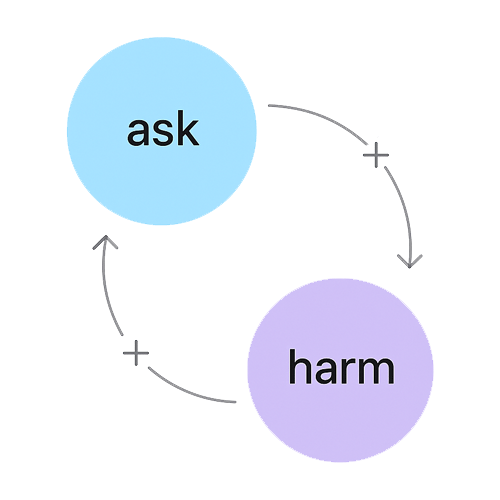
Instead of the system serving the MVM, it harmed the MVM at ever higher levels when the MVM asked for justice at higher levels. Ask for Justice <-> Harm.
It had started with asking for fairness and respectful treatment in housing, and that was met with harm, leading to the ask for justice, which was met with harm that escalated in response to ever more well engineered "asks".
This came to be called the "Ask<-->Harm Loop".
? Back to Where You Were | ? top
The Housing Crisis Context
Charleston, South Carolina faces a documented housing crisis whose severity demands systemic, not incremental, response:
- The average rent of $2,771 per month consumes approximately 57% of the average renter's monthly salary[4] — while even the metro median rent of $2,062 runs 7.2% above the national median, with shelter costs outpacing overall inflation (3.6% vs. 3.0% CPI).[15]
- North Charleston holds the nation's highest eviction rate among cities over 100,000 population: 16.5% — with an eviction filing rate of 35.62% and an average of ten evictions per day.[3][16]
- Nearly half (46%) of Charleston County renters are housing cost-burdened, and almost one in four pays more than half their income toward housing.[1]
- Statewide, only 47 affordable rental homes exist for every 100 extremely low-income households — a deficit of 79,089 units. A Charleston-area worker must earn $35.00 per hour to afford a two-bedroom at Fair Market Rent; a minimum-wage worker would need 3.1 full-time jobs to afford even a one-bedroom.[17]
- Housing prices increased at more than twice the rate of household income between 2010 and 2022 (83.2% vs. 41.2%),[2] creating affordability pressure that disproportionately crushes the most vulnerable members of the housing system — while it costs a landlord just $50 to file for eviction.[16]
- Four of the five U.S. cities with the highest eviction rates are more than 48% African-American, revealing that this crisis lands along lines of historic structural inequality.[16]
? Back to Where You Were | ? top
Study Purpose and Scope
This Housing Justice Audit presents a systems study, analysis and paradigm-level intervention based on studying the response of the Charleston housing and housing justice ecosystem to pull from its Most Vulnerable Member role (the unrepresented, harmed tenant) for fairness and justice between mid-2025 and early 2026.
Employing the Thaut Process of Strategic Thought Leadership[21] enhanced for this application with both the Vanguard Method's outside-in study methodology[13], and the Most Vulnerable Member (MVM) stress-testing approach drawn from embedded journalism and constitutional audit traditions, the study documented recursive failure patterns that escalated a fraud, privacy, and tenant exploitation dispute into an eight-to-nine-figure remedy pull (AKA Failure Demand)[10], revealing a system optimized for extraction and ejection rather than remediation and stewardship.
It could be argued that this was "just one case" but the Thaut Process Listening method (Audience Attunement) validated the widespread nature of the central mental model at the root of the problem, so this case could reasonably be referred to as a microcosm for housing injustice problems everywhere. The prevalent problematic paradigm has been identified as well as its solution: a leverage point for global positive change in housing and housing justice systems.
This audit discover that it is time for a new dominant paradigm in rental housing and the accompanying intervention is in the process of installing a Thought Leadership Model called Conscious Co-Stewardship (CCS), which aligns tenant, owner, and manager with shared values and beliefs around reverence for the shelter life stories play out in.
By reading this, you acknowledge you are self-selecting into this system of change. Even if you are approaching as a critic, you are giving energy to CCS with your attention.
? Back to Where You Were | ? top
Summary of Methodology
The core method for this Audit and Intervention is Strategic Thought Leadership (STL), which builds on Systems Thinking and provides insight into the deep structure of the problem state, applies imagination with solution-paradigm packaging Thought Leadership Model building and impact through its distribution with STL Schema.
We will unpack these terms in depth as we proceed through this report.
The distinctive circumstances of this audit and intervention dictated importing and utilizing several adjacent disciplines, including:
- The Outside-In Study Method of the Vanguard Method, as designed by John Seddon, and
- The MVM (Most Vulnerable Member) method that stress-tests a system through the strength of its weakest link: how well it treats its most vulnerable member.
- Donella Meadows' Leverage Points model defines optimum system intervention points, and
- Neuro-Linguistics provided the switching perceptual positions skillset necessary to pivot between the Most Vulnerable Member role and the Systems Analyst role.
Housing Justice Audit Methods Summary Table
Layer |
Source |
Role in HJA |
|---|
Study Platforms |
Systems Thinking and the "Listen" aspect of the LEO model of STL | The former: finds system dynamics, the latter:reveals "values gaps" |
Change Platform |
Strategic Thought Leadership Envision and Output aspects |
Fills "values gaps", with distributed Thought Leadership Models |
System Engagement Study |
Vanguard Method "Outside-In" Study (Seddon)[5] |
Study response to end-user at point of customer exchange. |
Most Vulnerable Member (MVM) |
Honor Your Oath[10], Embedded Journalism, Undercover Boss |
Stress-Test system from "weakest link". |
Systems Intervention Framework |
Meadows' Leverage Points |
Maps where the HJA intervenes (Paradigms, Information Flows, Rules) |
Enabling Skill |
NLP Perceptual Positions |
Dual-role (MVM + Analyst) possible by pivoting center of attention |
? Back to Where You Were | ? top
Principal Findings
The audit documented six escalating levels of systemic corruption activated when the MVM exercised statutory rights: operational fraud (falsified USPS postmark), retaliatory eviction (6 days after safety requests, during August heatwave), privacy weaponization (21-platform syndication of tenant images obtained under false pretenses), coordinated Big Law litigation warfare (frivolous motions, discovery obstruction, DARVO tactics), regulatory capture (LLR investigation obstruction, witness tampering), and a policy-profit feedback loop in which a Charleston Affordable Housing Commission member privately profited from the same extraction practices the Commission exists to counteract.
The core key finding is the "Ask<-->Harm Loop" wherein the system responds to a Most Vulnerable Member pulling for respect, fairness, then justice (when the first two aren't produced) with escalating levels of harm in response.
As McNeil wrote in the Open Letter to Charles S. Altman and Jonathan S. Altman -property owners behind the system, "There is zero ambiguity. The system responds with harm. It doesn’t just deny value; it punishes the attempt to access it."
A system that responds with harm instead of help in housing is obviously a big problem, and not just for tenants.
Referencing the aforementioned UK Study, Seddon's theory of Failure Demand - demand caused by a failure to do something right for the end user - suggests these compounding system failures aggravate the housing crisis by at least 50%[9] through unnecessary displacement, legal warfare, and other waste generated when systems respond to rights assertion with escalating suppression rather than remediation[10].
The Glasgow Housing Association case study, which applied Vanguard Method systems thinking to the UK's largest social housing landlord (73,000 homes), documented the same structural dynamic: an organization whose perceived purpose was "collecting rent" but whose practiced purpose was "chasing arrears," generating 80% failure demand, 20,000+ property refusals, and nearly 1-in-5 tenancy failures within 12 months. After systems intervention, arrears fell from £10.1M to £7.99M, eviction proceedings dropped 90%, and lettings within four weeks rose from 49% to 67%.[8][9][10]
? Back to Where You Were | ? top
What Follows
The remainder of this report documents the origin story and context (Origin), the detailed methodology (Methods), the findings across six levels of escalating systemic corruption (Findings), the interpretation through systems dynamics (Interpretation), the three-track intervention prescription (Intervention), and the documented choice point that makes this a live systems experiment rather than a retrospective study (Conclusion). Each section is structured with navigable title/introduction and subsections accessible through bookmarks.
This is both a study and an instrument of change - a documented demonstration that the Charleston Housing and Housing Justice system, when stress-tested by its Most Vulnerable Member exercising statutory rights, cascades into self-reinforcing harm that compounds this housing stability and mass privacy invasion dispute into potential eight-to-nine-figure liability, revealing that the system is optimized not for the purpose its members would articulate but for the extraction paradigm its design unconsciously serves.
? Back to Where You Were | ? top
References
- Housing Our Future: Comprehensive Housing Plan for Charleston County: Transit-oriented housing development plan. Charleston County, Spring 2023.↩
- Palmetto State Housing Study 2023: Supply and Demand Analysis: SC Housing & Darla Moore School of Business, University of South Carolina. Financing Housing. Building SC.↩
- New Housing Court Will Address High Eviction Rates in North Charleston: ABC News 4. Reports on 2018 Princeton University study finding North Charleston had the highest eviction rates in the nation.↩
- Charleston Housing Crunch Strains Affordability, Equity: SC Biz News. Analysis of Charleston’s housing affordability crisis and equity impacts.↩
- Evaluating Systems Thinking in Housing: Journal of the Operational Research Society, 2007. ODPM evaluation of Vanguard Method applied to UK social housing repairs.↩
- Housing Justice Audit of the Charleston, SC Housing and Housing Justice System: Draft V 1.2, 2026. Systems analysis via MVM stress-testing and STL Schema paradigm intervention.↩
- Housing Justice Audit: Origin: Origin narrative documenting the study’s emergence from lived experience through systems intervention design.↩
- Transforming Glasgow Housing Association: A Case Study: Seddon, J. & Brand, C. From Delivering Public Services that Work. GHA arrears reduced £10.1M to £7.99M; eviction proceedings down 90%.↩
- Taking on the System: Seddon, J. Public Finance, April 2008. Analysis of how public service targets produce adverse effects on intended outcomes.↩
- A Chat with John Seddon about Failure Demand: YouTube. Seddon defines Failure Demand: “demand caused by a failure to do something or do something right for the customer.”↩
- Places to Intervene in a System: Meadows, D. Polycrisis.org. Twelve leverage points where intervention can profoundly alter system behavior.↩
- 2023 South Carolina Annual Action Plan & SRDP Manual Draft: SC Housing. AP-65 Homeless and Other Special Needs; OMB-controlled federal housing program documentation.↩
- The Vanguard Method in a Systems Thinking Context: SPAR Editorial. Outside-in study methodology: “Study how the system responds to pull from the outside in.”↩
- Housing and Systems Thinking: Professor Ken Gibb et al. UK Collaborative Centre for Housing Evidence (CaCHE). Working paper on applying systems thinking to housing policy.↩
- Charleston Rent Growth Persists Despite National Cooling: ABC News 4 / WCIV, January 28, 2026. Reports Charleston metro median rent at $2,062 (7.2% above national median) with shelter costs outpacing overall CPI.↩
- North Charleston’s Eviction Rate Is the Highest in the U.S.: Charleston City Paper, April 18, 2018. Analysis of Princeton Eviction Lab data: 35.62% filing rate, 10 evictions per day, $50 filing cost, and racial demographics of top eviction cities.↩
- 2025 South Carolina Housing Profile: National Low Income Housing Coalition, November 2025. Documents 79,089-unit deficit for extremely low-income households; Charleston-North Charleston MSA Housing Wage of $35.00/hr; minimum-wage worker needs 3.1 full-time jobs for one-bedroom.↩
- DARVO: Deny, Attack, Reverse Victim and Offender: Freyd, J.J. University of Oregon. Defines the perpetrator strategy of reversing victim and offender roles when confronted with accountability.↩
- Institutional Betrayal: Freyd, J.J. University of Oregon. Framework for understanding harm inflicted by institutions upon those dependent on them, including failure to prevent or respond to wrongdoing.↩
- The Magic of Multiple Perspectives: Thought Leadership Studio Podcast. Application of NLP Perceptual Positions to systems analysis, strategic communication, and role-based perspective shifting.↩
- The Thaut Process of Strategic Thought Leadership: thaut.io. Three-stage Listen–Envision–Output (L-E-O) methodology for audience-attuned paradigm creation and deployment.↩
- Honor Your Oath: First Amendment Audits: Jeff Gray. Constitutional stress-testing methodology: exercising rights from the most vulnerable position to reveal whether institutions serve or suppress citizens.↩
- The 7 Levels of Learning and Influence: Thought Leadership Studio. The “Pullamid” framework mapping audience values, mental models, and pull across seven hierarchical levels for paradigm-level communication.↩
- The 9 Building Blocks of a Thought Leadership Model: Thought Leadership Studio. Structural components of Strategic Thought Leadership including the L-E-O methodology, Thought Leadership Position, and paradigm deployment architecture.↩