Interpretation
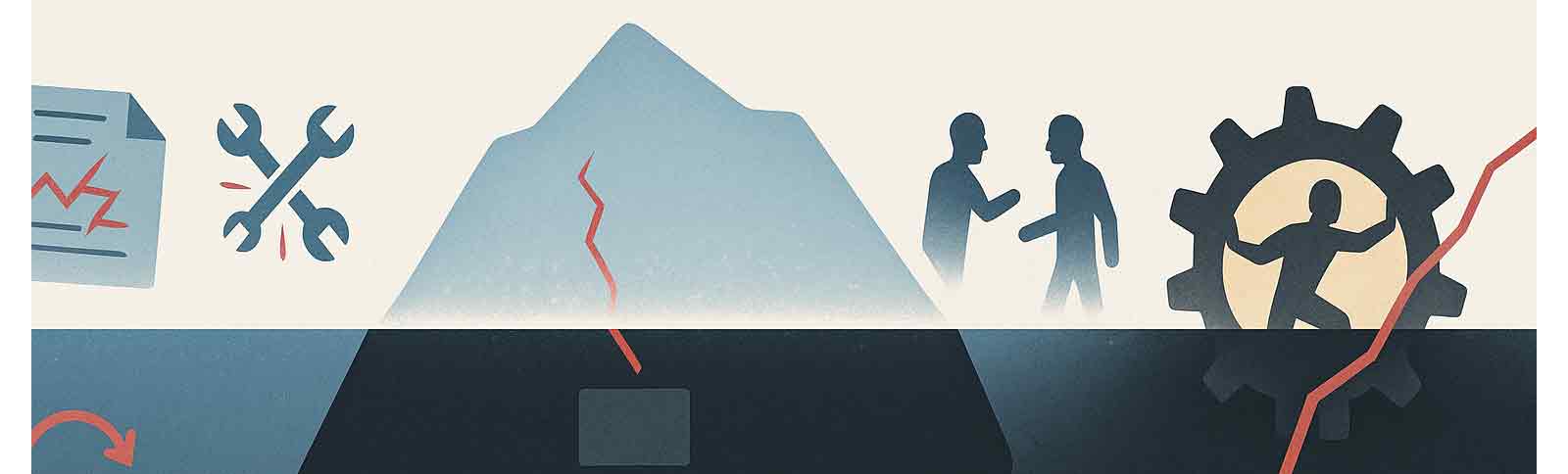
The core System Behavior is to harm the asker of fairness or justice in respond to the ask, and to escalate the harm in response to escalated asking until a limit is found. This led to a nervous breakdown and 76 out of 80 (severe level) PCL-5 PTSD score.
Interpretation
Iceberg Model Analysis
This analysis employs the Iceberg Model (Meadows, Donella Meadows Project, Systems Thinking Resources) to move from the visible events of this case: each individual harm - downward through recurring patterns, enabling structures, and root mental models.
Table: The Iceberg Model of Housing Justice Per System Study of McNeil v SAC 181, LLC
Iceberg Level |
How it Shows Up for this Case |
|---|
Events |
(Alleged) Institutionalized Bullying, Gaslighting, Misrepresentation, Exhaustion Tactics, Obstruction, Retaliation, Financial Exploitation, Dignity harm escalating to health harm. |
Patterns |
Escalation of harm in response to perceived vulnerable member (unrepresented tenant) asking for service and fairness, then justice when those aren't given. Regardless of the nature of the ask, the higher-level the ask, the more the harm escalates. Willful blindness by the owners who enable through funding the system. Harm via agents of a bad actor. Misuse of shared resources (court, insurance pool). Regulatory capture protects from accountability, further lowering standard of performance to the public. |
Structures |
Hierarchical design where money flows down from owner to central agent, but tenant well-being feedback does not flow back up. Central agent funded by enabling owner delegates through additional agents. Such agents utilize the backed up state of the court system to evade judicial accountability long enough to further pollute it with frivolous filings designed to prevent the vulnerable from accessing justice. Opaque entity structures to make it difficult to identify owners and hold them accountable, closed-system management of such entities. In general, the system is designed to harm the powerless who ask it for fairness or justice, apparently to prevent them from accessing resources. |
Mental Models |
Core Mental Models Behind This: - Passive Investing: The hidden assumption behind "Passive Investing" is "Unconscious Abdication", which is about rental property owners' permission to themselves to "look away" while agents harm to stop pulls for service, fairness, or justice;
- Justice Requires Status: which basically means "It's OK to stop the vulnerable from accessing Justice" and which supports the "Unconscious Abdication" model "Looking away" from "lawfare" enables abuse of vulnerable in litigation, while adding massive hidden waste through what Seddon would call "failure demand" and Strategic Thought Leadership calls "remedy pull": more stress on the system due to not providing its function properly the first time to the Most Vulnerable Member.
|
As per Donella Meadows' Places to Intervene in a System, paradigms are the highest level of system intervention.=
And paradigms are simply prevalent mental models accepted as fact.
Changing policy, rules, feedback design, or even system purpose are lower-level interventions that cannot fully succeed if they are undermined by a faulty paradigm.
And housing is undermined by such a faulty paradigm:
The Core Pattern: Ask (for Fairness, Service, Justice) <--> (Receive Escalating) Harm
One of the System Archetypes Identified: "Tragedy of the Commons" applied to the court system itself
The Root Cause: Two Primary Dysfunctional Mental Models that Support a Primary False Narrative.
The Primary Dysfunctional Mental Models:
- a hidden assumption behind Passive Investing: "Unconscious Abdication" (passive investing without oversight) that treats housing as a mechanical extraction system rather than a social system where shelter anchors human life stories;
- "Justice requires Status" which creates a multi-tiered justice system through assumptions about unrepresented litigants and violates the constitutional rights to equal access to justice.
Those Mental Models Create Vulnerability to False Narrative System Capture. The False Narrative Held by Defense in McNeil v SAC 181, LLC et al: "Didn't Happen".
The "Didn't Happen" False Narrative
The “Didn’t Happen” stance of defense is the gaslighting position that 7/8 original major harms in the case never happened, with none of them ever being acknowledged by defense, let alone addressed directly with evidence engagement.
Coordinated communication under this frame, combined with ongoing harassment and exhaustion tactics, created the late January 2026 nervous breakdown and concurrent 76/80 PCL-5 “extreme” PTSD score of Plaintiff McNeil. It is noteworthy that McNeil re-took the PCL-5 on May 6, 2026 and scored 72/80 for the preceding month, still in the “extreme” category due in part to the stress of navigating this high-stress situation of whistleblowing on a power structure that includes local government, a multi-billion dollar development project, the local court, law enforcement agencies, and the dominant Newspaper of the area, all of which are operating under at least one of these three harm-creating models.
? Back to Where You Were | ? top
The Perfect Storm in the Charleston Court System
The Tragedy of the Commons is the Systems Archetype behind both the movie and the situation "The Perfect Storm".
The movie depicts the final voyage of a fishing boat out of Gloucester, Massachusetts in 1991 that sailed into a once-in-a-century convergence of weather systems. But the film’s deeper story is about why the crew went out in dangerous conditions at all.
They ventured that far out to sea out of the hardship resulting from a "system stock crash" due to the Tragedy of the Commons archetype: individuals acting in their own self interest depleted a common stock so it eventually crashed, with everyone involved suffering.
In that case, by the early 1990s, decades of individual fishermen maximizing their own catch depleted the North Atlantic cod and groundfish stocks to the point of near-collapse. This depletion created the desperation to catch the now hard-to-find fish, sending the boat on a mission that ended in disaster.
When the common stock is exhausted, individual actors take increasingly dangerous actions to extract the diminishing remainder.
The Court System as Depleted Commons
The judicial system is also a shared resource: a commons. Its capacity (judge time, calendar availability, clerk processing bandwidth, the integrity of the adversarial truth-seeking process) is finite and replenishes slowly. Every motion filed, every hearing scheduled, every discovery dispute adjudicated draws from this common pool.
The archetype maps directly onto the litigation behavior documented in this case:
The Mechanism in This Case
The documented litigation pattern in McNeil & Poyer v. SAC 181, LLC et al. (2025-CP-10-05095) reveals multiple defense attorneys across two law firms paid by willing insurance carriers and independently filing motions that might seem individually rational (from a billable-hours standpoint at least) but collectively devastating to the commons:
- Phelps Dunbar files an AI sanctions motion (Nov 10) speculating that pro se competency must come from ChatGPT, without evidence, and contradicted by pre-AI litigation history against their own client. Individual intended gain: the intent was to force pro se to spend days responding instead of building their case, but it backfired as Plaintiffs utilized their response to publicly document the defense's extensive (alleged) malfeasance. Commons cost: judge time consumed evaluating a meritless motion.
- Resnick & Louis files coordinated motions to quash bank record subpoenas (Jan 8 & 12) — 42 days before the LLR regulatory deadline. Perceived individual gain: blocks evidence corroboration for their client. Commons cost: sabotages a public protection investigation; judge time consumed on discovery disputes that obstruct regulatory function.
- Coordinated reframing across all defense filings characterizes an 8-count fraud case as a “deposit dispute.” Individual gain: minimizes perceived severity for the court. Commons cost: the truth-seeking function of the adversarial system is degraded when officers of the court systematically misrepresent the nature of the claims before them.
- Witness tampering — AppFolio contacted Jan 9 (federal 18 USC 1512). Individual gain: disrupts evidence chain for Meridian. Commons cost: corrupts the evidentiary foundation the entire system depends on.
? Back to Where You Were | ? top
Category Error: Social vs Mechanical
In "On the Mismatch Between Systems and Their Models," Ackoff and Gharajedaghi formally classify systems into four types:
- deterministic,
- ecological,
- animate, and
- social systemic,
and argue explicitly that treating social systems (whose parts are choice-making people) with mechanical/deterministic models produces system failures. [Ackoff, R.L. & Gharajedaghi, J. (1996). "On the Mismatch Between Systems and Their Models." Systems Dynamics Review]
Rental housing is a social system. Its components are not inanimate parts like gears in a machine - they are members: tenants, owners, and property managers, each a self-directed system with their own goals, values, and capacity for choice.
A mechanical system serves a purpose defined by its designer, and when a part breaks, you throw it out and put a new one in. But in a social system, the relationship inverts: the whole has to serve the parts, because the parts are people.
When a property management operation treats a tenant who demands respect and fair treatment as a squeaky part to be ejected, it commits exactly the category error Ackoff warned against - applying a mechanical model to a social system. The results of that error are on full display in this case.
iCategory error is a helpful way to describe the nature of the root cause of the paradigm this audit identifies as Unconscious Abdication - the hidden assumption beneath what the rental housing industry calls "passive investing." This leads an owner to delegate into a system designed as if tenants are replaceable machine components rather than people whose life stories play out inside the shelter being managed.
But this category error of treating a social system like a mechanical system is like watering your cat ... or trying to get a houseplant to chase a laser.
The mechanical system model creates the cascading failure demand - legal battles, turnover costs, regulatory complaints, reputational damage - that John Seddon's Vanguard Method research found accounts for up to 70% of incoming demand in service systems that get the category wrong.
It forgets that it is the end user - the tenant - who feeds money into the system and therefore sets its value.
The perceptual distortions of:
- the commitment of long term contracts,
- the time lags before downstream pushback from poor service,
- the high cost of switching providers, and
- the fact that shelter is a primary, basic human need...
... make that core systemic truth harder to notice, but they don't erase it.Thus, with housing, one has to step back enough to see the pattern, but, as Seddon might state, it still holds true that, since the end-user sets the value of the service, only by designing it from their point of view can you fully maximize profits and flush out waste.
? Back to Where You Were | ? top
The Thaut Process begins with Listen - Audience Attunement - sorting authentic marketplace thinking into seven levels of learning and influence called the Pullamid.
These seven levels, derived from Robert Dilts' Logical Levels model and refined for Strategic Thought Leadership, parse thinking from the highest (Core Purpose) down through Identity, Values, Mental Models, Skillset, Pull (expressed demand), and Pullfillment (the experience of the result). The critical insight from this structure is that higher levels change those beneath them, but lower levels do not change higher ones. This is why Donella Meadows ranks paradigms (mental models at scale) as the second-highest leverage point for system intervention.
Applying the Listen phase to authentic online conversations where tenants, investors, and landlords speak openly about their struggles reveals a striking pattern: both the tenant and the investor audiences have a deep fracture between their Values (Level 3) and their Mental Models (Level 4). They value benevolence, agency, dignity, and peace of mind - but they operate on mental models of Futile Resistance and Capitalist Trade-Off that make those values impossible to fulfill. The Audience Baseline Position (ABP) Pullamids below capture this fracture as documented through neuro-linguistic analysis of public conversations.
ABP Pullamids: The Empowerment-Deprived Tenant and the Ethically Conflicted Investor
Level |
Empowerment-Deprived Tenant (ABP) |
Ethically Conflicted Investor (ABP) |
|---|
1. Core Purpose |
Justice and Efficacy. They want to see fairness prevail, but more than that, they want to feel that their actions matter. |
Financial Autonomy and Legacy. The goal is financial freedom - not having someone direct them at work one day. |
2. Identity |
"Victim" / "Cynic." They identify as the powerless party in a rigged game. Years of seeing bad actors win have created Learned Helplessness. |
"Frugal Hard Worker" vs. "Greedy Capitalist." Self-perception is fractured - they feel like a good person doing a bad thing. |
3. Values |
1. AGENCY (Unmet). 2. Justice. 3. Dignity. 4. Security. The deepest unmet value is Agency - the feeling that their choices and actions can shape their own outcome. |
1. INTEGRITY (Unmet). 2. Benevolence. 3. Fairness. 4. Freedom. He values goodness just as much as freedom, which creates the internal conflict. |
4. Mental Models |
"Futile Resistance." Being legally right is irrelevant; having more power and money is what wins. The system is rigged to protect them, so fighting back only leads to exhaustion and retaliation. |
"The Capitalist Trade-Off." "If I don't buy the building, someone else would... this is the byproduct of a capitalistic society." Financial success requires a moral compromise. |
5. Skillset |
Grievance Documentation. Skilled at collecting evidence (emails, photos) but lacking the strategic framework for how to utilize that evidence effectively. They have the ammo but not the gun. |
Financial Engineering and Renovation Management. Can analyze rents 20% below market and execute a rehab plan, but lacks the ethical framework to handle the human cost of the strategy. |
6. Pull |
Validation and Venting. They search online forums to confirm they are not crazy ("Is this illegal?") and to share stories of injustice. They are pulling for communal support because they have lost faith in institutional support. |
Seeking Validation and Ethical Permission. The pull demand is not just for ROI, but for a framework to resolve guilt. "What framework do you use to think about all the ethical dilemmas?" |
7. Pullfillment |
Despair and Paralysis. The experience of knowing they are right but being powerless to stop the abuse leads to profound despair. Trapped, unable to fight and often unable to leave. |
Guilt and Social Friction. Instead of feeling successful, he feels shocked by the tenants' distress and defensive against his friend. The result of investment is a damaged self-image. |
The fracture is visible: both audiences hold higher values (Agency, Integrity, Benevolence, Dignity) that their operative mental models actively prevent from being fulfilled. The tenant's "Futile Resistance" model blocks Agency. The investor's "Capitalist Trade-Off" model blocks Integrity and Peace of Mind. Both models share the same root assumption: housing is a zero-sum mechanical system where one party's gain requires the other's loss. This is the category error Ackoff identified - treating a social system as if it were a mechanical one - expressed as the lived experience of real people on both sides of the relationship.
? Back to Where You Were | ? top
The Ask<-->Harm Loop
The Core Pattern: Ask for Fairness, Service, or Justice, and Receive Escalating Harm
Try the interactive "Loopy" causal loop diagram below by clicking the "up arrow" on the "Ask" circle. See how the system responds. "Reset" starts over, the slider control changes the speed, and "Remix" lets you experiment with building out the causal loop diagram yourself. See the Open Letter to the Altmans for an example of building out such diagrams to assist with "working on the system".
The MVM (Most VUlnerable Member) stress-test documented in this case confirmed the Listen-phase diagnosis with empirical precision. When a tenant exercising statutory rights pulls for basic value fulfillment - return of a security deposit, respectful communication, clear expectations - the systems optimized around the "Passive Investing (Unconscious Abdication)" mental model responds as predicted: by escalating harm rather than resolving the demand.
? Back to Where You Were | ? top
Passive Investing System Design
How does the Ask<-->Harm Loop show up in Passive Investing oriented Rental Housing and Housing Justice System Design?
More on Systems Thinking
This is a good point for further clarification of the definition of
Systems Thinking, which Strategic Thought Leadership builds on.
Systems Thinking is about more effectively working with and getting things done through systems, a category of interactions with the world that nearly all of us do nearly every day of our lives, even if we don't recognize them as such at the time.
So what makes an assemblage of components a system rather than merely a collection of those components?
A true system must possess three distinct components:
- Elements: The visible, tangible pieces of the system (e.g., players, trees, or gears).
- Interconnections: The relationships, physical flows, or communication signals that hold the elements together.
- Function or Purpose: The overall objective, behavior, or outcome that the system achieves over time.
The Separation Test
To determine if you are looking at a system or a collection, ask these three diagnostic questions:
- Can you divide it in half and still get the same behavior?
- Collection: If you divide a pile of sand in half, you simply get two smaller piles of sand. It is a collection.
- System: If you cut a cow in half, you do not get two smaller cows. You destroy the system. And I hope you can make it to the fence before that bull over there reaches you.
- Do the pieces interact, and does that interaction matter?
- Collection: Items in a shopping cart do not interact; changing a carton of milk for a loaf of bread changes nothing else in the cart.
- System: In a football team, changing the quarterback completely changes how every other player on the field performs.
- Does the behavior persist over time?
- Collection: A pile of leaves on the lawn reacts only to external forces like the wind; it has no internal drive or pattern of behavior.
- System: A tree actively responds to seasons, changes colors, drops leaves, and seeks water to fulfill its inherent purpose of survival.
System Boundaries
The soft drink machine we hope to get a Coke or bottled water from is such a system. We can define the system boundaries around that system to include just the machine and consider that a mechanical system of parts - or we can draw a larger boundary around the system of "convenient drink delivery" that also includes people who stock these machines and remove coins and bills from them as they make their rounds, the management of those people, their vehicles, the warehouse and its management ... the list goes on.
We want to draw a boundary that makes a system both understandable and manageable, though, so we need to consider what are the essential elements to include.
Generally, system boundaries are flexible, and how well a human-designed system performs often pivots on where the design boundary is drawn. Now we are moving into system design and that boundary selection is an aspect of using Systems Thinking to design better systems more consciously.
Without that, we end up with systems designed unconsciously that often don't work very well for any of the "system members" or "roles within the system". A rental property management system designed through "unconscious abdication" or passive investing might include:
- The Property Owner: The owner of the property rented, often an investor with multiple units, who delegates (unconsciously abdicates) to ...
- The Property Manager: a rolewhose purpose, from the point of view of the "passive investing" owner, is to extract rent from tenants and minimize costs, and
- The "Agents of Harm": the pre-litigation employees of a property management company operating with an extraction model rather than a service model, insurance-paid defense attorneys, and others whose role it is to assist in extracting from tenants and prevent them from accessing service or justice.
Who does it exclude in this conceptualization model?
- The tenant: the end user who funds the system with their rent payments.
The problem with that? The tenant is the role of the paying customer, the role that sets the value of the service of housing management.
Thus, as we can see, those "key role excluding" system designs don't always work like we would hope, especially when a system boundary is unconsciously chosen that excludes a role the system impacts. Imagine a soft drink machine that didn't consider the customer who wants a drink. It would take money and not emit a drink.
A business depending on such vending machines would have a short life. But housing, while a service business, has perceptual distortions that make it easy to forget that and easy to draw system boundaries that don't include the end customer on which the financial performance depends: the tenant.
Let's consider a diagram showing a system design for passive investing that didn't design for the tenant, or MVM/ Most Vulnerable Member.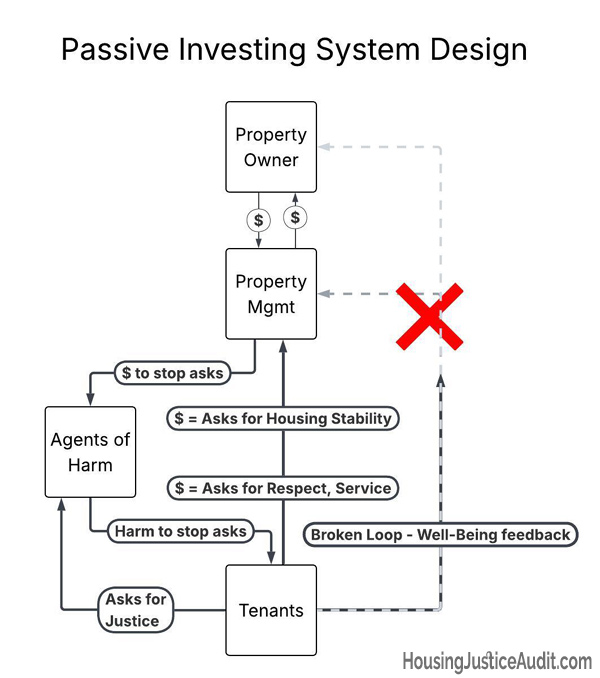 There's a broken loop - money flows down the hierarchical design that results from the top-down thinking of passive investing, but feedback on tenant well-being does not flow back up, with predictable results, as we've seen in McNeil v SAC 181, LLC et al.
The tenant role, the MVM (Most Vulnerable Member) of the system, asks for fair treatment and receives misrepresentation of landlord-tenant laws. The tenant asks for safer living conditions and receives a "ghost" Notice to Vacate 6 days later. The tenant asks for respect and receives mass syndicated images of their private life published on at least 25 online platforms without their knowledge or consent for about 10 weeks until discovered.
Then, when the tenant role seeks justice, the system response is gaslighting, retaliation, coordinated legal warfare, discovery obstruction, regulatory obstruction, and institutional cover-up. Each escalation confirms the tenant's Audience Baseline Position (ABP) ("the system is rigged") while simultaneously implementing the investor's ABP ("Passive Investing = look away while agents harms and this is just the cost of doing business") until a balancing limit is found. McNeil v SAC 181, LLC et al, along with this emergent Housing Justice Audit Report, is such a limit.
? Back to Where You Were | ? top
Tragedy of the Commons in Charleston SC Court of Common Pleas
And it isn't just the tenant role who is harmed by such a dysfunctional system design.
One particularly harmful result is the "Perfect Storm" system structure Tragedy of the Commons occurring in the court system itself, as documented in this report. But the system structure is driven by the paradigm beneath it - the mental model of Unconscious Abdication that treats housing as a mechanical extraction system.
This is why rules-based interventions (stronger tenant protections, higher penalties, more enforcement) operate at low leverage points on Meadows' scale. They do not address the fracture between values and mental models that drives the behavior. A fully effective intervention must operate at the paradigm level.
The intersection harmful models identified in this study - including the "Didn't Happen" false narrative, the "Justice Requires Status" the Charleston Court of Common Pleas and defense attorneys operate under, and the "Passive investing" (Unconscious Abdication) model that is a focus of this study - have a yet deeper root mental model beneath them, one that might best explain the "Ask<-->Harm Loop":
You have to take from others in order to succeed. The "Zero-Sum Game" viewpoint.
That "win-lose" mindset reveals a mechanical world view where you have to take in order to have.
Creating value where none existed before is alien to this mindset. To reference Robert Anton Wilson, it's the difference between Pavlov's dog - mechanical cause-effect in one direction - and Schrodinger's cat - consciousness creates what we perceive as reality and observed limits are usually if not always limits of perception that can be changed.
With that shift to non-zero sum thinking, we can support thought leadership positions along the lines of
"If you design for the vulnerable, then the system is stronger which means we all benefit from a better system."
Which is a nice properly formulated mental model in the most malleable if->then=meaning structure - as a counterpoint to the consistently constructed Audience Baseline Position of
"If we obstruct the vulnerable it helps us which means we win by beating others."
Even an opponent in the adversarial legal system would want to win through skill and a better set of facts rather than cheating and "grinding down" - or even using methods indistinguishable from psychological abuse and smear campaigns - which doesn't bring a sense of personal growth from self development in a challenging environment nor does it free themselves and their clients from the weight of accumulated moral injury.
So which will it be, Pavlov's Dog or Schroedinger's Cat?
? Back to Where You Were | ? top