May 28 Hearing Context & Open Letter to the Court
![]()
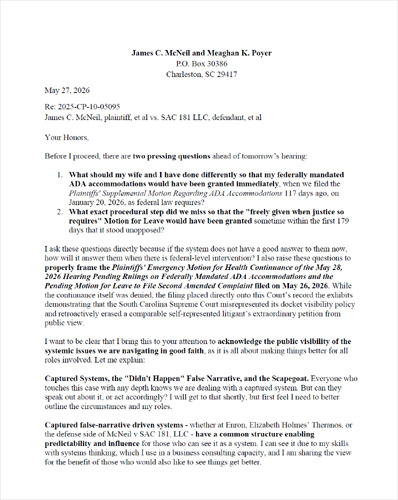
On May 28, 2026, a pivotal hearing takes place in the Charleston County Court of Common Pleas. The proceedings occur as a disabled unrepresented Plaintiff enters the court with 72-76 out of 80 PCL-5 tested “extreme” level PTSD and after waiting 117 days for ADA Accommodations requested that were never granted.
The letter identifies that the local justice system currently operating under a "Justice-Requires-Status" (JRS) model that marginalizes the Most Vulnerable Member (MVM) while protecting special interests through capture by a coordinated false narrative that the primary harms of the case "Never happened".
The Open Letter below is published to establish absolute, undeniable transparency ahead of this hearing.
It diagnoses the systemic defect, highlights the severe 42 U.S.C. § 1983 liability vulnerabilities of staff who participated in gatekeeping dockets, and offers an off-ramp and a paradigm-level intervention.
By escalating to the federal level and ensuring public visibility, this letter serves as a gift of structural cover. It empowers the good-faith actors inside the court to safely reject special-interest pressure and align their actions with the principles of justice and equity at the heart of court integrity and public trust.
 Unable to view the pdf on your mobile device?
Download the PDF
Structural Context: The May 26 Emergency Motion
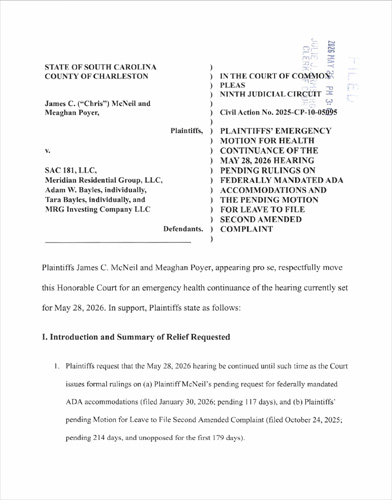
To fully understand the structural reality of the May 28 hearing, one must review the Plaintiffs' Emergency Motion for Health Continuance, filed on May 26, 2026. While the court ultimately denied the continuance, the filing successfully executed its primary structural purpose: permanently placing critical exhibits onto the trial court record.
This filing documents severe systemic anomalies, including evidence that the South Carolina Supreme Court misrepresented its docket visibility policy and retroactively erased a comparable self-represented litigant’s extraordinary petition from public view.
It serves as a stark demonstration of the Constitutional crisis concerning Access to Justice in South Carolina, and the extreme lengths to which a captured system will go to protect a "didn't happen" narrative and avoid accountability.
 Unable to view the pdf on your mobile device?
Download the PDF